Internationally acclaimed for the Neo-Tantra art and symbolic abstractionism, Prabhakar Barwe is an icon of modern Indian art. Born in 1936 in a Maharashtra family having rich art tradition, Barwe pursued studies in Sir JJ School of Art, Mumbai. He
Internationally acclaimed for the Neo-Tantra art and symbolic abstractionism, Prabhakar Barwe is an icon of modern Indian art. Born in 1936 in a Maharashtra family having rich art tradition, Barwe pursued studies in Sir JJ School of Art, Mumbai. He was deeply inspired by Paul Klee, a Swiss-German artist. It was reflected in his early watercolors and works with floating motifs on a transparent surface done in a mostly symbolic mode.
During his stay at Varanasi, he got the opportunity to work in the Weavers Service Centre developing modern Indian textile design. Here he came across the tantric symbolism that set the tantric-oriented abstract format of his life's work. He also made use of the conceptual devices of surrealism by placing simple objects and ephemeral shapes in his representations. With the introduction of the Pop Art Movement, banal everyday objects were made into fine arts and Barwe applied this showing great skills in creating intimacy between these objects and life. He later began reading horoscopes that eventually turned into a hobby. The pieces of writing containing astrologer's calculations and predictions eventually found their place on Barwe's canvas.
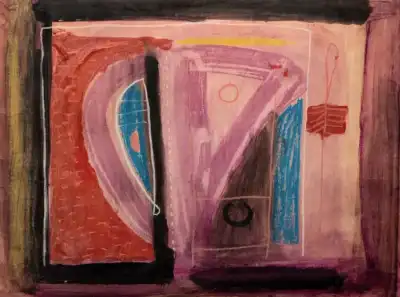
His work presents ordinary objects having emotional and mystical associations, vibrating with poetic sensibility. The junction of form and space in his work creates new associations and meaning while giving the observer a chance to perceive the image subjectively.
Barwe was awarded the Academy of Fine Arts Award in Kolkata, the Bombay Art Society Award, the Maharashtra State Award, the prestigious Lalit Kala Akademi Award in 1976 and the Yomiuri Shimbun Award from Japan.
Internationally acclaimed for the Neo-Tantra art and symbolic abstractionism, Prabhakar Barwe is an icon of modern Indian art. Born in 1936 in a Maharashtra family having rich art tradition, Barwe pursued studies in Sir JJ School of Art, Mumbai. He was deeply inspired by Paul Klee, a Swiss-German
Internationally acclaimed for the Neo-Tantra art and symbolic abstractionism, Prabhakar Barwe is an icon of modern Indian art. Born in 1936 in a Maharashtra family having rich art tradition, Barwe pursued studies in Sir JJ School of Art, Mumbai. He was deeply inspired by Paul Klee, a Swiss-German artist. It was reflected in his early watercolors and works with floating motifs on a transparent surface done in a mostly symbolic mode.
During his stay at Varanasi, he got the opportunity to work in the Weavers Service Centre developing modern Indian textile design. Here he came across the tantric symbolism that set the tantric-oriented abstract format of his life's work. He also made use of the conceptual devices of surrealism by placing simple objects and ephemeral shapes in his representations. With the introduction of the Pop Art Movement, banal everyday objects were made into fine arts and Barwe applied this showing great skills in creating intimacy between these objects and life. He later began reading horoscopes that eventually turned into a hobby. The pieces of writing containing astrologer's calculations and predictions eventually found their place on Barwe's canvas.
His work presents ordinary objects having emotional and mystical associations, vibrating with poetic sensibility. The junction of form and space in his work creates new associations and meaning while giving the observer a chance to perceive the image subjectively.
Barwe was awarded the Academy of Fine Arts Award in Kolkata, the Bombay Art Society Award, the Maharashtra State Award, the prestigious Lalit Kala Akademi Award in 1976 and the Yomiuri Shimbun Award from Japan.